


Italian and German ryegrass in forage production
Italian ryegrass is highly valued for forage production. It is characterized by high yield, good nutritional value, and versatile uses for silage, fresh feeding, and grazing. It plays a particularly important role during periods of rising temperature accumulation, as it effectively utilizes winter moisture and grows rapidly in spring. These characteristics also make it a frequently used winter cover crop. Furthermore, Italian ryegrass contributes to the design of integrated management systems due to its high nutrient uptake and intensive root system. Ryegrasses also play a significant role as cultivated plants in crop rotations. They are used as undersown crops, for grass seed propagation, or as components of cover crop mixtures and therefore frequently occur as volunteer weeds on affected areas, with up to 1,500 ryegrass heads per square meter. Perennial ryegrass, in particular, is often found along field margins and roadsides.
Challenges arising from the use of ryegrass in arable farming
To control perennial ryegrass in arable farming, preventative measures such as crop rotation, sowing time, and mechanical management are crucial. Extended crop rotation and cover cropping can help mitigate the problem. Intensive tillage, such as targeted plowing, can reduce the seed bank in the soil. Later sowing dates for winter cereals and good field hygiene also contribute to reducing perennial ryegrass infestation. Tillage with a plow is particularly effective in this regard. Seed dormancy is minimal, which improves the efficiency of stubble cultivation under dry conditions, as emerging seedlings are mechanically destroyed. Late sowing of winter cereals is preferable whenever possible, as it leads to significantly lower perennial ryegrass infestation and higher herbicide efficacy. Trials in Saxony showed that postponing sowing to mid-October reduced ryegrass infestation (ears per m²) by 85–90% and increased the efficacy of pre-emergence herbicides from 70% to 97%. Under favorable weather and soil conditions, plowing can bury a large proportion of the newly formed seeds, causing them to die. Cleaning harvesting equipment before moving to a different field or mulching ryegrass patches before harvesting can very effectively reduce seed dispersal from field to field.
Resistance problems in ryegrasses
In some regions of Germany, resistance of Italian ryegrass to various herbicide classes has been observed. This poses a particular challenge for arable farming, as many active ingredients are no longer approved and a further reduction in the herbicide portfolio is expected. Resistance often arises through repeated application of the same mode of action, which selects for resistant individuals. Italian ryegrass can become completely resistant after just four treatments. The vast majority of resistance findings in ryegrasses relate to Italian ryegrass, with a frequent occurrence of resistance to ACCase inhibitors (active ingredients of HRAC group 1 (A), e.g., pinoxaden, propaquizafop, cycloxidim). This resistance occurs in combination with concurrent resistance to ALS inhibitors (active ingredients of HRAC group 2 (B), e.g., iodosulfuron, mesosulfuron, pyroxsulam, thiencarbazone). Soil-active herbicides, such as flufenacet (HRAC group 15/K3), can also be affected by resistance, but in most cases, they remain sufficiently effective. While resistance to ACCase inhibitors is often caused by target-site resistance, the efficacy of other herbicide classes is usually reduced by metabolic processes. Resistant ryegrasses are found in almost all arable farming regions. So far, resistant ryegrasses have been reported primarily in southern Hesse, Saxony, eastern Thuringia, and Mecklenburg-Western Pomerania.
Agricultural and crop management measures for controlling ryegrass
To control perennial ryegrass in arable farming, preventative measures such as crop rotation, sowing time, and mechanical management are crucial. Extended crop rotation and cover cropping can help mitigate the problem. Intensive tillage, such as targeted plowing, can reduce the seed bank in the soil. Later sowing dates for winter cereals and good field hygiene also contribute to reducing perennial ryegrass infestation. Tillage with a plow is particularly effective in this regard. Seed dormancy is minimal, which improves the efficiency of stubble cultivation under dry conditions, as emerging seedlings are mechanically destroyed. Late sowing of winter cereals is preferable whenever possible, as it leads to significantly lower perennial ryegrass infestation and higher herbicide efficacy. Trials in Saxony showed that postponing sowing to mid-October reduced ryegrass infestation (ears per m²) by 85–90% and increased the efficacy of pre-emergence herbicides from 70% to 97%. Under favorable weather and soil conditions, plowing can bury a large proportion of the newly formed seeds, causing them to die. Cleaning harvesting equipment before moving to a different field or mulching ryegrass patches before harvesting can very effectively reduce seed dispersal from field to field.
Chemical control of ryegrass
Effective control of perennial ryegrass requires a combination of chemical and non-chemical methods. Chemical control should be achieved through the use of herbicides with different modes of action to prevent resistance. Perennial ryegrass plants can be controlled chemically almost exclusively with the active ingredient glyphosate. Few herbicides or herbicide groups are available for controlling ryegrass plants germinated from seed. In winter cereals, perennial ryegrass species should be regularly monitored in the autumn to counteract yield losses due to competition and the limited control options available in the spring. Provided no resistance has yet developed, chemical control of perennial ryegrass is possible with selective, foliar-applied herbicides from HRAC groups 1/A, 2/B, and 5/C2. The active ingredient chlortoluron belongs to the photosystem II inhibitor group (C2).
Nufarm recommendation
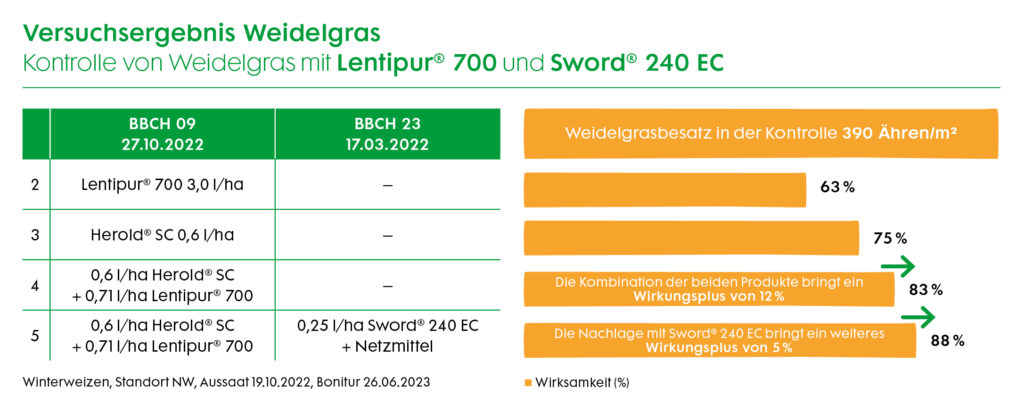
In the presented trial results from 2022, 2,100 g/ha CTU (3.0 l/ha Lentipur® 700 ) alone showed an efficacy of 63%. In combination with flufenacet-containing products, an increase in efficacy of 8% was achieved. A further application of Sword® 240 EC with the active ingredient clodinafop (240 g/l) increased the efficacy by a further 5%. Lentipur® 700 is recommended for pre-emergence application with a grass partner and supports the control of blackgrass, ryegrass, cornflower, chamomile, and wild chervil.
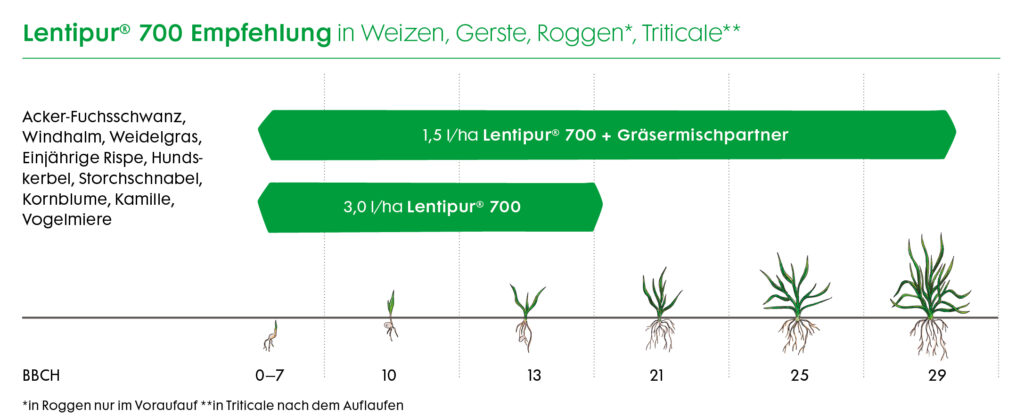
In combination with a grass partner, we recommend 1.5 l/ha Lentipur® 700 to support control of blackgrass, ryegrass, chamomile, cornflower and dog’s-foot tartare in autumn.
Regarding the products:
Probleme mit Weidelgras? Wir beraten Sie . jetzt anfragen:
„*“ zeigt erforderliche Felder an


 Twitter
 Facebook
 WhatsApp
 Email
Email